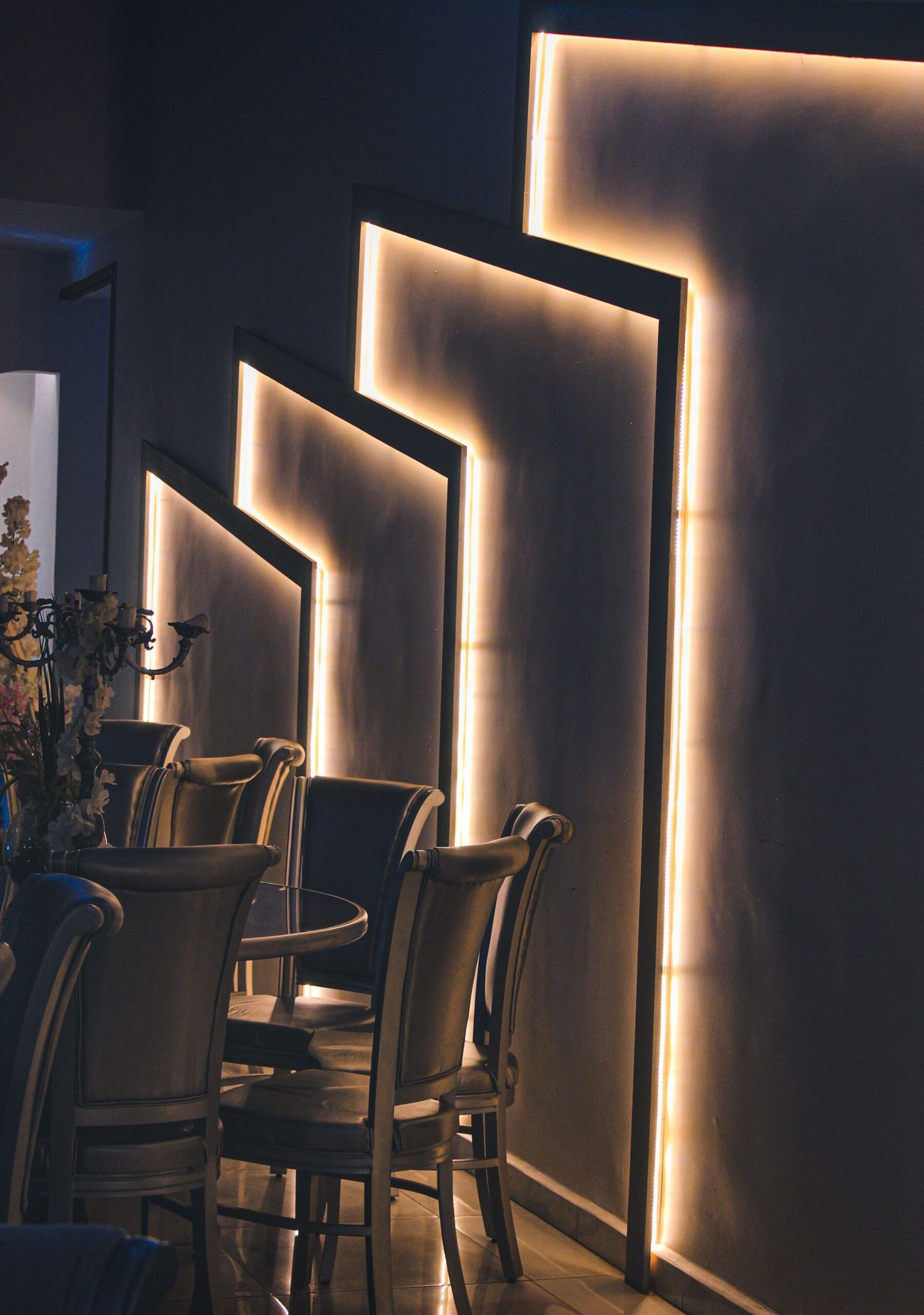
24V LED Strip Lights for Stable Low-Voltage Installations
Product photographs show the appearance of 24V LED strip lights, but dimensions, voltage, optics and control determine whether the product works in the intended space.
What this product group is designed to do
On LEDUA, “LED strip light” is used for rigid linear LED lines or bars rather than flexible tape. The category contains 12V, 24V and 220V versions, with fixed lengths and different light temperatures. Rigid bars are useful when the project needs a straight, repeatable line of light and a predictable mechanical base. They are especially convenient in furniture, display and utility lighting where a flexible PCB is not necessary.
In the LEDUA range, this page concentrates on 24V rigid linear LED bars suited to low-voltage systems with reduced current compared with equivalent 12V loads. It is relevant to furniture, retail displays, architectural details and longer low-voltage lighting circuits. The category therefore has a narrower technical purpose than a general lighting page, which helps buyers compare products that share the same installation logic.
Because 24V LED strip lights is rigid, mechanical dimensions are a first-order parameter. The bar should fit the available bay without interfering with hinges, shelf supports or cable entries. In a series of display cases, repeating the same length and mounting position also makes the finished lighting look consistent from one unit to the next.
Rigid LED lines can be used as straightforward functional lighting or hidden behind a diffuser. If the light source is visible, attention should be paid to glare and LED point visibility. If it is concealed, the distance to the illuminated surface determines whether the result is a narrow bright stripe or a wider wash.
Use a sample to verify the visual result
When appearance matters, test one section of 24V LED strip lights with the real materials before ordering the full quantity. Surface colour, glass, polished stone, painted metal and glossy furniture can change perceived brightness and create reflections that are not obvious in a specification table.
A sample also confirms mounting tolerances, cable exits and access to controls. Once approved, document the spacing and fixing method so the installer can reproduce the same result throughout the project.
Parameters to check before ordering
Use a written checklist instead of relying on a single headline specification. For 24V LED strip lights, the following points are especially relevant:
- Length and physical size: rigid LED lines are supplied in fixed formats, so the bar length must match the furniture or installation bay.
- Light colour: choose warm, neutral or cool white, or a coloured variant, according to the task and nearby materials.
- Mounting and diffusion: check whether the product is used bare, behind a cover or inside a furniture detail that controls glare.
- Supply voltage: 12V and 24V lines need a compatible power supply, while 220V products require mains-rated connection components.
Balance appearance, output and serviceability
A lighting detail is successful only when it looks good both switched on and switched off. With 24V LED strip lights, check visible housings, cable exits, fasteners and transitions between illuminated and non-illuminated areas. In furniture, retail displays, architectural details and longer low-voltage lighting circuits, these details are often close to eye level, so untidy mounting can be more noticeable than a small difference in luminous flux.
The products in this area are distinguished by 24V rigid linear LED bars suited to low-voltage systems with reduced current compared with equivalent 12V loads. Use the visual requirement to narrow the category first, then confirm the electrical and mechanical specifications. This sequence usually produces a more coherent result than selecting the brightest available product and trying to hide the technical compromises later.
Because this article focuses on a 24V product family, the supply architecture should be fixed before cable routes and controllers are finalised. Mixing voltages within one repeated detail creates avoidable service problems, so label supplies and connection points clearly when several systems share the same project.
Power-system considerations
At the same power, a 24V system draws roughly half the current of a 12V system. That can make cable sizing and voltage-drop control easier on medium-length runs, while still keeping the lighting on a low-voltage supply.
For the current LEDUA selection and product specifications, see https://leduastore.com/led-strip-light/led-strip-light-24v/.
Selection summary
Before ordering 24V LED strip lights, confirm where it will be mounted, what surface it has to illuminate, how it is powered and how it will be controlled. Once those points are fixed, comparing products becomes faster and the finished lighting is much easier to predict.