
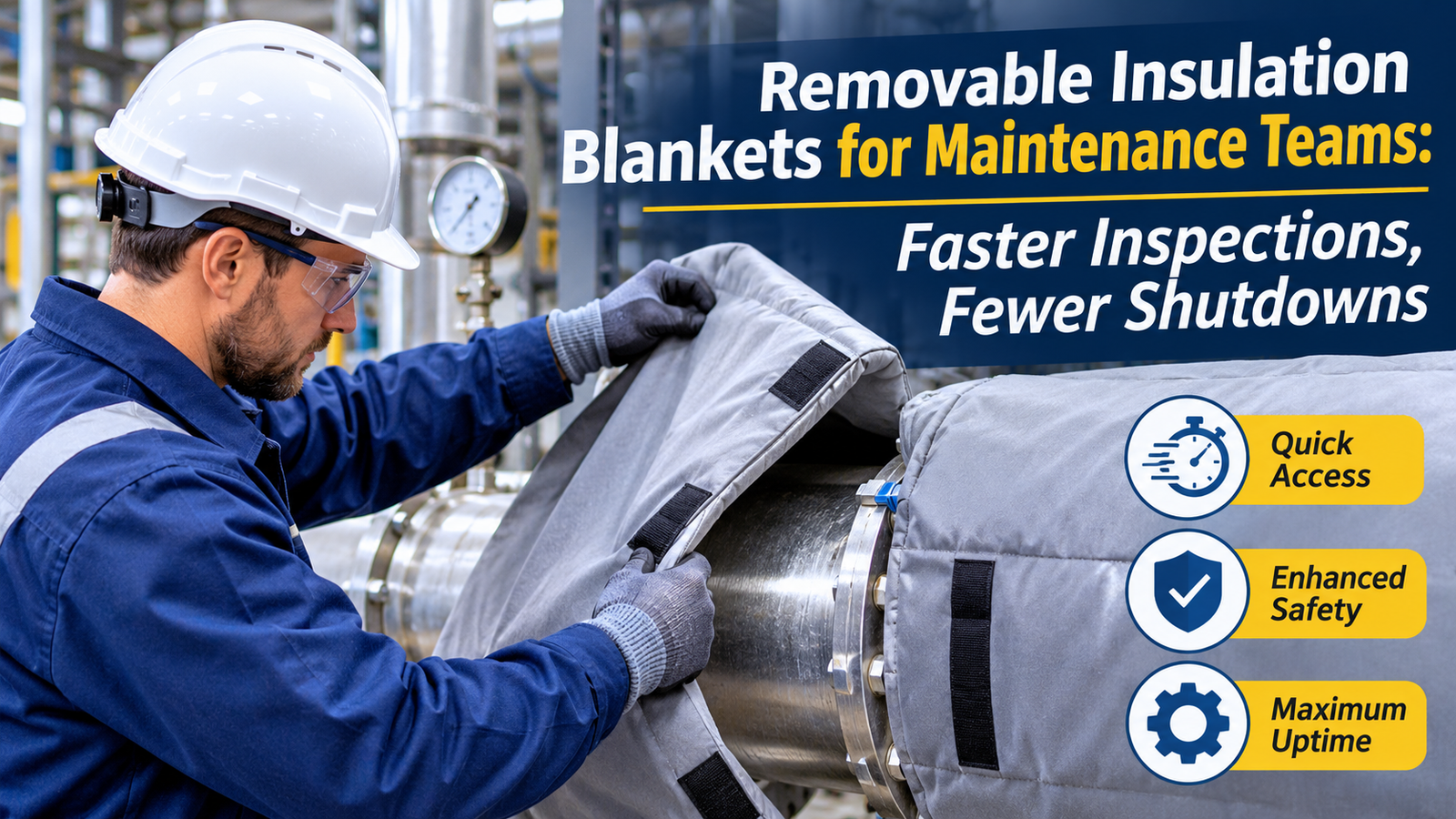
Removable Insulation Blankets for Maintenance Teams: Faster Inspections, Fewer Shutdowns
Every maintenance supervisor knows the feeling. A valve starts weeping, a flange needs a torque check, or a steam trap is acting up. The fix itself might take twenty minutes. Getting to the component is what eats the afternoon.
Permanent insulation protects equipment and saves energy, but it also hides the parts you need to see. That tradeoff has pushed many plants toward removable insulation blankets, which give maintenance crews quick access without giving up thermal performance. This article covers how they work, where they help most, and what to consider before you specify them.
The Hidden Cost of Hard-to-Reach Components
Traditional insulation on valves, flanges, pumps, and turbine casings is often built for permanence. Rigid pipe covering, mastic, and metal jacketing hold up well, but they have to be cut, pried, or demolished to get at the equipment underneath.
That creates a few predictable problems:
- Delayed inspections. If removing insulation takes an hour and a work order, inspections tend to get pushed back.
- Damaged material. Cutting away old insulation often ruins it, so crews need to replace it instead of reinstalling it.
- Patchwork repairs. After a quick fix, insulation is often put back loosely or left off entirely. Bare surfaces waste energy and create burn hazards.
- Longer outages. When insulation removal sits on the critical path of a repair, it adds hours to the job.
None of these problems are dramatic on their own. Together they add up to lost labor, extra material cost, and more time with equipment offline.
How Removable Insulation Blankets Work
Removable insulation blankets are custom-sewn covers built to fit a specific component. They typically combine three layers:
- An inner face fabric that handles direct heat exposure.
- An insulating core, such as fiberglass, silica, or ceramic fiber, chosen for the operating temperature.
- An outer fabric that resists moisture, oil, abrasion, or chemicals depending on the environment.
Closures such as straps, buckles, hook-and-loop fasteners, or lacing hardware hold the blanket in place. A technician can usually remove one by hand, or with basic tools, then reinstall it when the work is done. Because the blanket is patterned to the component, it fits snugly around irregular shapes like valve bodies and flange bolts, which are the places where standard insulation is hardest to install.
Faster Inspections Mean Problems Get Caught Earlier
Inspection frequency often depends on how easy inspection is. When a technician can lift a blanket off in a couple of minutes, checks happen more often and with less friction.
That matters for several routine tasks:
- Visual checks for leaks and corrosion. Small weeps and early corrosion are easy to spot when the surface is exposed, and expensive to fix once they progress.
- Bolt torque verification. Flange bolts relax over time under thermal cycling. Quick access makes retorquing part of normal rounds.
- Thermography support. Infrared surveys can be more informative when crews can compare insulated and exposed conditions.
- Packing and gland adjustments. Valve stem packing often needs attention long before a full overhaul.
Catching a minor issue during a routine walk-down is far cheaper than finding it after an unplanned trip. That is the real link between removable insulation and fewer shutdowns. The blanket does not prevent failure on its own. It makes the early warning signs easier to find.
Reducing Shutdown Time During Turnarounds
Planned outages are tight. Every task is sequenced, and delays cascade. Insulation removal and reinstallation is one of those tasks that tends to be underestimated in the schedule.
With conventional insulation, crews may spend a significant portion of a turnaround stripping and rebuilding. With removable covers, that work shrinks considerably, and it can often be done by the same technicians already working on the equipment instead of a separate insulation crew.
A few practical benefits show up in outage planning:
- Fewer trades involved. Less coordination between mechanical and insulation contractors.
- Predictable reinstallation. Blankets are labeled and fit one way, so there is little guesswork.
- Reusable material. Covers that come off intact can go back on, which cuts waste and reorder lead time.
- Cleaner worksites. Less cutting and debris during a busy outage.
Actual time savings depend on the component, the original insulation system, and the crew. Treat any estimate as something to verify against your own work history instead of a universal number.
Where Removable Insulation Makes the Most Sense
Not every surface needs a removable cover. Fixed insulation is still the right call for long, straight pipe runs that rarely need attention. Removable blankets earn their place on components that are touched often:
- Valves, including gate, globe, check, and control valves
- Flanges and couplings
- Steam traps and strainers
- Pumps and pump casings
- Turbine casings and expansion joints
- Heat exchanger heads
- Instrumentation and sampling connections
- Exhaust components and manifolds
A useful rule of thumb is to ask how many times a year someone has to get to that component. If the answer is more than once, a removable cover is worth considering.
Safety and Energy Benefits Beyond Access
Access is the main draw, but there are two other reasons maintenance and facility teams like this approach.
Personnel protection. Exposed valves and flanges are common sources of contact burns. A properly fitted cover lowers the outer surface temperature, which helps protect people working or walking nearby. Check your site’s surface temperature targets and applicable safety guidance to confirm what is required.
Energy retention. Uninsulated fittings lose a surprising amount of heat compared with the pipe around them. Because removable covers make it easy to restore insulation after maintenance, they help prevent the common problem of components being left bare for months. For steam and hot process systems, that can mean real fuel savings over time.
What to Consider Before You Specify
A cover that is poorly matched to the application will disappoint. Before ordering, work through these questions:
What is the operating temperature? Include both normal and peak conditions. The core and facing materials must be rated for the highest exposure, with margin.
What is the environment? Oil, water, chemicals, welding spatter, and outdoor weather all affect outer fabric choice. A cover that works well in a dry boiler room may fail quickly in a wet or oily area.
How often will it be removed? Frequent removal calls for durable closures and reinforced stress points.
How accurate are the measurements? Fit drives performance. Gaps at the edges let heat escape and reduce the benefit. Provide dimensions, photos, or drawings, and note anything unusual such as bolt protrusions or support brackets.
Does it need to be labeled? Tagging each cover with the equipment number saves time when dozens of similar valves are involved.
Who is making it? Experience with custom textile fabrication matters here. Ask about material certifications, lead times, and whether the supplier can adjust patterns for hard-to-fit shapes. Domestic manufacturing can also shorten lead times and simplify documentation.
Maintenance Habits That Extend Cover Life
Even well-built covers last longer with basic care:
- Inspect for tears, crushed insulation, and damaged closures during routine rounds.
- Keep covers dry. Wet insulation loses performance and can hide corrosion.
- Store removed covers off the floor and away from sharp edges or spills.
- Reinstall fully, with all straps and closures secured, before returning to service.
- Replace any cover with saturated or contaminated material, since it no longer insulates as designed.
The Bottom Line
Insulation should protect equipment and people without becoming an obstacle to the people who keep that equipment running. For components that need regular attention, removable insulation blankets offer a practical balance: strong thermal performance, easier inspections, and less downtime when something has to come apart.
Start small. Walk your facility, list the components that cause the most delays or get inspected most often, and evaluate those first. A few well-chosen covers can make a noticeable difference in how smoothly your maintenance program runs.