
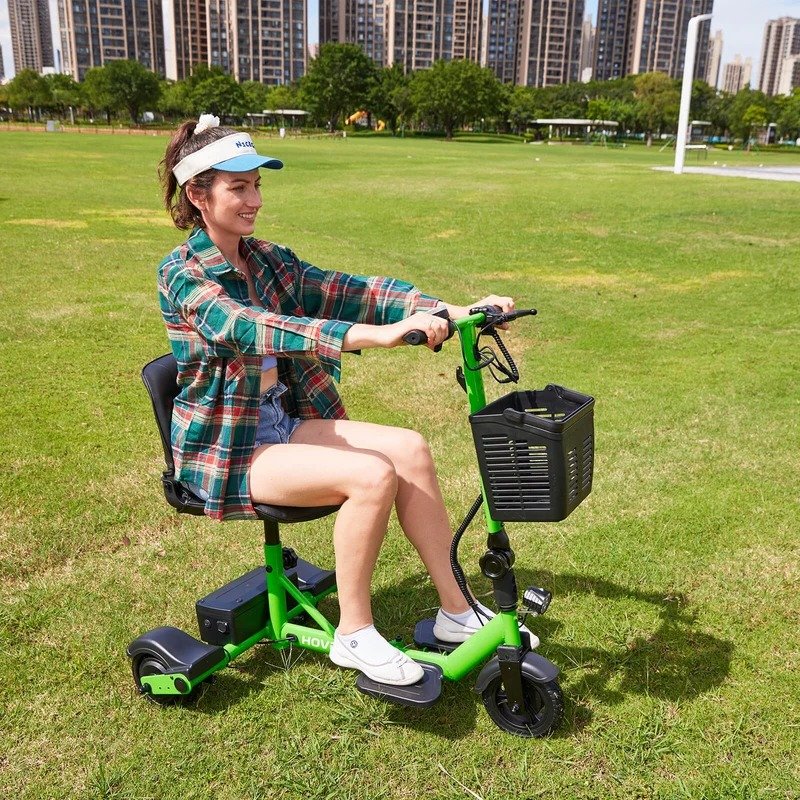
Portable Mobility Scooters and How to Choose the Right One
A portable mobility scooter is a folding or breakdown-style electric scooter light enough to lift into a car trunk, stow on a plane, or roll behind a suitcase. Anyone who travels often or drives a sedan rather than a van tends to land in this category once a full-size scooter proves too bulky for daily errands and weekend trips.
What Makes a Mobility Scooter Portable
Two specs decide it. The folded footprint determines whether the scooter fits in your trunk, and the weight of the single heaviest part determines whether you can actually lift it without help.
A scooter that folds neatly but weighs 95 pounds in one piece still creates a loading problem. Look for units that split into a chassis, battery pack, and seat so each component stays under 30 pounds.
Folded Size and Lift Weight
Portable models usually fold to a height between 13 and 18 inches. Total weight ranges from 35 to 65 pounds across most travel-class units released in 2025 and 2026. Always compare folded dimensions against the actual trunk opening of your vehicle before buying. A unit like the Hoverfly T3 3-wheel foldable scooter packs down to about 60 pounds and fits in a standard sedan trunk.
Three Wheels Versus Four for Portability
Three-wheel scooters fold smaller and weigh less than their four-wheel counterparts. They also turn more tightly in narrow indoor spaces. Four-wheel models add a fourth contact point for outdoor stability on uneven pavement. Most portable units in either configuration weigh under 80 pounds assembled.
Battery Rules for Travel With a Portable Mobility Scooter
If you intend to fly, the battery is the first spec to verify. Beginning January 11, 2026, the FAA limits installed lithium-ion batteries on powered mobility devices to 300 watt-hours per battery, with spare batteries capped at one unit of 300 Wh or two units of 160 Wh each, all carried in the cabin (FAA PackSafe, 49 CFR 175.10).
Watt-Hour Limits for Cabin Travel
| Battery Capacity | Allowed in Cabin | Airline Notice Required |
| Under 100 Wh | Yes | No |
| 100–160 Wh | Yes | Yes |
| 160–300 Wh | Yes (installed on device) | Yes |
| Over 300 Wh | No | Cargo only |
Lithium-metal (non-rechargeable) batteries are not permitted on mobility devices on any U.S. commercial flight (FAA, 2026).
Real-World Range
Range printed on a spec sheet assumes flat ground, no headwind, and a 165-pound rider. Plan for 60 to 75 percent of the rated number under typical city use. Most portable models deliver 10 to 17 miles per charge once weight, hills, and stop-and-go traffic enter the equation.
Comfort and Capacity of a Portable Mobility Scooter
A smaller scooter still has to support a real body. Travel-class units typically support riders up to 250 to 330 pounds and use a narrower seat than mid-size or heavy-duty scooters. Confirm the seat measures within an inch of your hip width, since a too-tight seat creates pressure points within an hour of continuous sitting.
The Hoverfly T4 4-wheel mobility scooter carries up to 330 pounds and uses a detachable battery, which keeps the heaviest separable piece manageable for solo loading.
Adjustable Parts That Matter
Tilting tillers and flip-up armrests matter more on small scooters than on full-size ones, because a compact frame leaves less room for body adjustment. A swivel seat also helps with side transfers from a chair or sofa. Check that footrests are flat and wide enough for your usual shoes.
Where Portable Mobility Scooters Fall Short
Compact scooters trade something for their size. Smaller wheels (typically 7 to 9 inches in diameter) make potholes feel harsher. Ground clearance averages 2 to 3 inches. Suspension is often basic or absent.
Anyone planning daily outdoor commutes over five miles, frequent gravel or grass routes, or regular rides on cobblestone should consider a mid-size or heavy-duty model. The portability advantage is not worth the daily discomfort in those scenarios.
FAQs
How much do portable mobility scooters weigh?
Most weigh 35 to 65 pounds total, with the heaviest separable piece staying under 30 pounds. This range covers nearly all folding 3-wheel and 4-wheel travel models sold today.
Are portable mobility scooters allowed on airplanes?
Yes, if the lithium-ion battery is removable and rated at 300 watt-hours or less. Notify the airline at least 48 hours before departure and bring the battery’s watt-hour certification.
What is the typical price range for a portable mobility scooter?
Consumer Reports tested ten models in January 2026, priced between $500 and $2,850. Budget folding units start near $500, while premium scooters with longer batteries and better suspension sit at the top of that band.